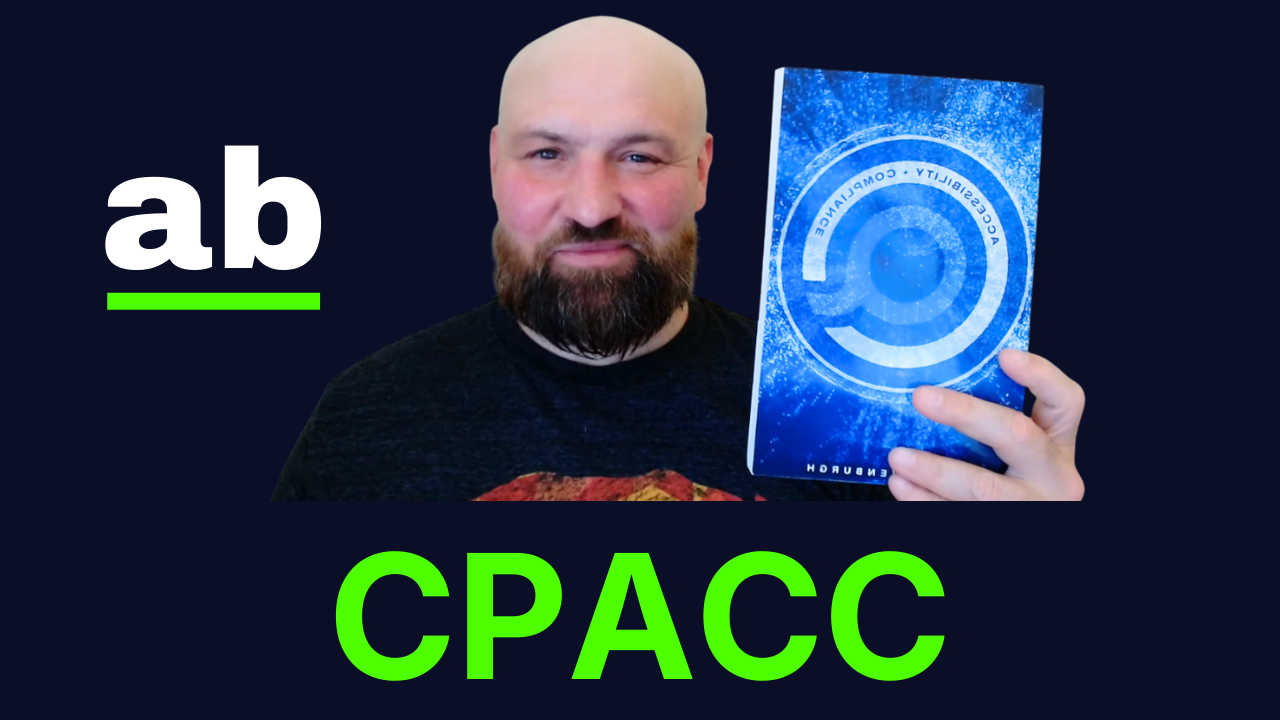
The IAAP CPACC certification covers three core areas: disabilities and the people who have them, accessibility and universal design, and accessibility-related standards, laws, and management strategies. It is a foundational, cross-disciplinary credential offered by the International Association of Accessibility Professionals. The exam tests breadth of knowledge rather than deep technical skill in any single area, which is why CPACC is often the first certification accessibility professionals pursue.
CPACC stands for Certified Professional in Accessibility Core Competencies. It signals that someone understands the foundational concepts that apply across digital, built environment, and policy contexts.
| Area | What It Covers |
|---|---|
| Disabilities | Types, models, demographics, and the lived experience of people with disabilities |
| Accessibility and Universal Design | Principles, assistive technology, and applied design across digital and physical environments |
| Standards, Laws, and Management | WCAG, ADA, Section 508, EN 301 549, organizational policies, and program management |
| Exam Format | 100 multiple-choice questions, 2 hours, computer-based or remote-proctored |
| Recertification | Every 3 years through continuing education credits |
Disabilities and the People Who Have Them
The first domain of the CPACC body of knowledge centers on understanding disability itself. Candidates learn about categories of disability including visual, auditory, motor, speech, cognitive, and psychological, along with how each type affects interaction with technology and the built world.
This section also covers the major models of disability: medical, social, biopsychosocial, economic, functional, and the charity or moral models. Knowing the difference between these models matters because each one shapes how organizations think about accommodation, design, and policy.
Candidates are also expected to know disability demographics, etiquette, and the language considerations that vary by community and region. Person-first language, identity-first language, and when each is preferred all show up in this domain.
Accessibility and Universal Design
The second domain shifts from understanding people to understanding the work of making things usable. This includes the seven principles of universal design, the difference between accessibility and usability, and how assistive technology fits into the broader picture.
Candidates study screen readers, switch devices, alternative input methods, captioning, and other assistive technologies. The exam does not require deep technical mastery of any one tool. It requires knowing what each tool does, who uses it, and why it matters.
This domain also covers accessible design across contexts: digital interfaces, physical spaces, transportation, consumer products, and services. CPACC is intentionally cross-disciplinary, which is part of what distinguishes it from more specialized credentials like the Web Accessibility Specialist (WAS).
What Standards and Laws Does the CPACC Exam Cover?
The third domain addresses the legal and standards context. Candidates need working knowledge of the Americans with Disabilities Act (ADA), Section 508, the Air Carrier Access Act, and the Twenty-First Century Communications and Video Accessibility Act in the United States.
International coverage includes the UN Convention on the Rights of Persons with Disabilities, the European Accessibility Act (EAA), EN 301 549, the Accessibility for Ontarians with Disabilities Act, and other national frameworks. Candidates should know what each law requires, who it applies to, and how enforcement works.
The Web Content Accessibility Guidelines (WCAG) are covered at a conceptual level. The exam tests familiarity with the four principles (Perceivable, Operable, Understandable, Robust), conformance levels (A, AA, AAA), and the role of WCAG 2.1 AA and WCAG 2.2 AA as the most commonly referenced standards. Deep technical evaluation against WCAG criteria is the domain of the WAS certification, not CPACC.
Organizational and Management Considerations
CPACC also covers how accessibility operates inside organizations. This includes procurement, vendor management, policy development, accessibility statements, training programs, and the role of leadership in driving accessibility maturity.
Candidates are expected to understand the business case for accessibility, including market reach, legal risk, and brand reputation. This is the domain where the exam intersects most directly with day-to-day work for consultants, program managers, and in-house accessibility leads.
Who Should Pursue CPACC
CPACC is designed for professionals whose work touches accessibility but does not require deep technical specialization. That includes project managers, product managers, designers, content creators, HR and legal team members, and consultants who advise clients across multiple disciplines.
Developers and auditors often start with CPACC and then pursue the WAS certification, which goes deeper into WCAG conformance evaluation and technical remediation. Holding both credentials earns the Certified Professional in Web Accessibility (CPWA) designation.
Frequently Asked Questions
Is the CPACC certification worth it for accessibility consultants?
For consultants who advise clients across digital, policy, and organizational topics, CPACC carries strong recognition. It signals foundational knowledge that clients and employers can verify. For consultants focused exclusively on technical WCAG evaluation, the WAS certification is typically a better fit, though many practitioners hold both.
How long does it take to prepare for the CPACC exam?
Most candidates spend two to four months preparing, depending on prior experience. The IAAP publishes a body of knowledge document that maps directly to exam content. Reading it carefully, supplementing with disability studies materials, and reviewing the major accessibility laws is the typical preparation path.
Does CPACC test WCAG technical criteria?
CPACC covers WCAG at a conceptual level, including its structure, principles, and conformance levels. It does not test deep technical application of individual success criteria. That technical depth is covered by the WAS exam.
How often does CPACC need to be renewed?
CPACC must be renewed every three years through continuing education credits documented with IAAP. Renewal confirms that certified professionals stay current with evolving standards, laws, and practices.
CPACC is a credential of breadth. It validates that a professional can speak the language of accessibility across disciplines, which is exactly what most accessibility work actually requires.
Looking for accessibility professionals with verified credentials? Contact the Accessibility Base directory to find consultants, auditors, and specialists.